When the going gets tough, the government goes shopping
- CTF Reacts to First Full-Blown Federal Budget in 653 Days
- Security Spending and Balanced Budget "No Brainers"
- Decade of Chretien / Martin Fiscal Management: Less-than-Stellar
- Abandonment of Full Contingency Reserve: Bad Omen for Future
- Payroll Taxes: Still Way too High
- Program Spending to Jump 20% over three years, including money for Broadband Boondoggle
OTTAWA: The Canadian Taxpayers Federation (CTF) has reacted to Budget 2001 - the eighth budget during Paul Martin's tenure as federal Finance Minister - tabled today in the House of Commons.
Overall Impression
"Finally Minister Martin seems to have overcome his budget dyslexia, after 653 days - as opposed to the customary 365 days between budgets - Ottawa has finally offered up some fiscal transparency for Canadians. This is a welcome change from the government by press conference and ministerial fiat that we've been subjected to for the last 22 months," stated CTF federal director Walter Robinson.
"While we are supportive of the general direction for security spending - a no-brainer if there ever was one - and maintaining a balanced budget, the fiscal devil, however, is in the spending details - and there is a lot of disquieting detail in today's budget," added Robinson.
The Chretien / Martin Fiscal Legacy -- The Big Picture
"Today's budget projections combined with the eight year legacy of financial management under the Liberal government shows Canada's performance is less-than-stellar," noted Robinson. "Although the February 2000 budget and last fall's pre-election mini-budget appeared to have us on the tax-relief highway, it is imperative that Ottawa honour its promised tax cut schedule in order to avoid the traffic jam of fiscal rut."
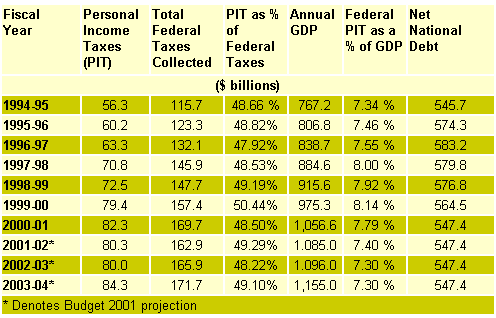
"We should be mindful of the fact that the so-called five-year, $100 billion tax cut plan really only amounts to $47 billion when bracket creep, CPP premium increases and Canada Child Tax Benefit payments are factored in. Measured as a percent of GDP, our federal personal income tax burden has not substantively changed in the last decade. Indeed it is higher today than when the Liberals took office in 1993."
Are we Abandoning our War on the Debt
"We are very concerned that Minister Martin has chosen to apply over 60% -- some $2.5 billion - of this year's contingency reserve to spending instead of using the budgeted $4 billion has a hedge against any future deficits," Robinson stressed. "This means that Ottawa did not reallocate from low-priority areas such as corporate welfare or HRDC grants and contributions to meet security needs and in so doing, has placed us perilously close to deficit should a further economic downtown occur."
"While we applaud the federal government for reducing $35.1 billion in net debt over the past four years, we should note that the debt today is still higher than when the Liberals took office eight years ago," stated Robinson. "And debt interest payments continue to chew up over $110 million every day of the year. Minister Martin has once again refused to institute a schedule of legislated debt reduction as advocated by the CTF and thereby, continues the fiscal crime of intergenerational tax evasion perpetuated against our children - tomorrow's taxpayers."
Payroll Taxes: Still Way too High
"Instead of dabbling in the failed Keynesian approach of public works spending to kick-start the economy, the government should have dramatically slashed EI premiums which remain as Canada's number one, profit-insensitive job killer," lamented Robinson.

"Come January 1st, Canadians will pay as much as $158 in new payroll taxes. While EI rates will drop a nickel, CPP premiums will skyrocket by 40 cents," said Robinson. "Ottawa could have used this budget to heed the calls of businesses large and small and the Auditor General to slash EI premiums and contribute to the economic recovery by liberating private sector capital. Instead, the federal government is trapped in the high payroll tax domain of previous governments although it is Canadian workers who ultimately become the economic prisoners in this scenario."
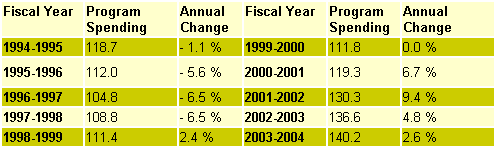
Program Spending Summary ($ billions)
"Canadians understand the need for security investments but these expenditures were not found by scaling back corporate welfare, shutting down regional development agencies or ending some of the $16 billion in discretionary grant spending identified by the Auditor General last week," added Robinson. "As a result program spending will rise by 20% over the next three years alone."
Infrastructure Initiatives
Today's budget announces a variety of initiatives to facilitate more rapid cross border flows of goods, services and people crucial to Canada's prosperity. A one-time $2 billion contribution will also be made to a Strategic Infrastructure Foundation that will operate arms length from government. "If this agency redirects gas tax revenues back to Canada's crumbling roads, that would be a step in the right direction. But the key here is governance. If this Foundation becomes a home for patronage appointees then we're right back to political pork barreling with tax dollars being funneled to canoe museums and bocce ball courts."
A Federal Airports Agency
"Setting up a not-for-profit agency to for aviation security issues smack of more bureaucracy," Robinson said. "The challenge post-9/11is not to embrace bureaucracy as a solution for security concerns. Rather, it is to effectively structure regulations for passenger safety and baggage screening activities with existing stakeholders. But on a positive note, the $12/flight user fee approach to finance this activity is laudable."
Broadband Boondoggle
Today's budget committed $115 million over three years to rural broadband Internet access. "Without a doubt, this is a big-time boondoggle. It is similar to the hypothetical example of the government putting a fax machine in every Canadian home in 1990," said Robinson. "The vast majority of commercial applications to be derived from broadband technology - pushing content down the highspeed pipe - will accrue to the private sector, so let them foot the bill. This is not the role of government."
Aboriginal Spending
Today's budget devoted $185 million in new spending for aboriginal Head Start and strategies to battle fetal alcohol syndrome (FAS) over the next two years. "No one discounts the severity of problems ranging from FAS to substance abuse to teen suicides in our aboriginal communities at rates much higher than the Canadian average. But Ottawa's continued piecemeal approach is not working," stressed Robinson. "It's time to think big picture and ask where the $10 billion of annual tri-partite government support for native communities is going How it can be better allocated And what fundamental structural changes must be made in the relationship between taxpayers and Canada's native communities "